


BGProReg: A biomechanically generative framework for prostate MRI-TRUS deformable image registration
Information Fusion (IF=15.5)
Abstract
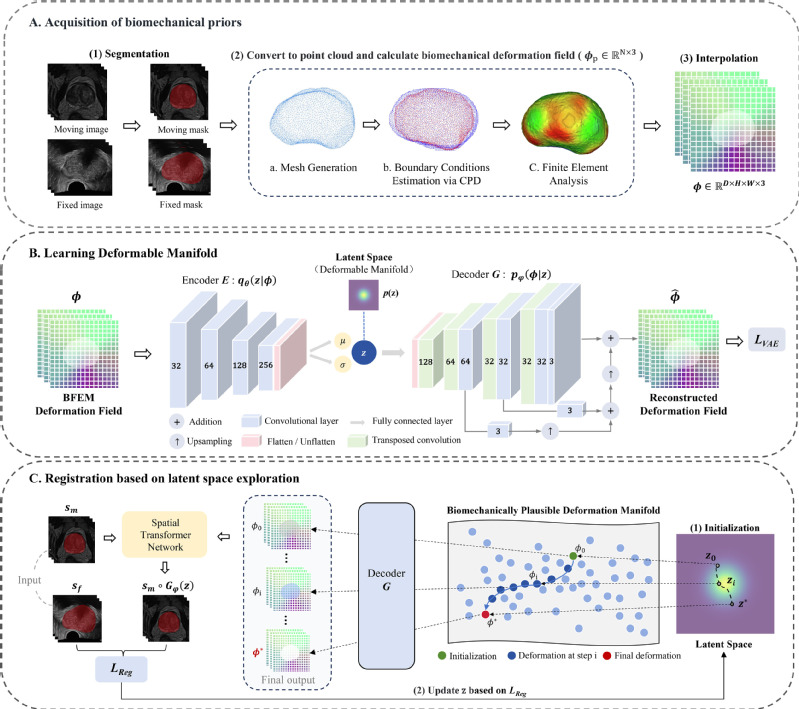
MRI-TRUS image registration is critical for targeted prostate interventions. However, significant differences between MRI and TRUS make it challenging to capture cross-modal feature correspondences, while intraoperative deformation caused by probe compression further complicates the registration. Existing methods often use weakly supervised learning strategies based on prostate labels, with explicit regularization terms to ensure smooth deformation fields. While the regularization term can prevent unrealistic deformations such as folding, these methods often overemphasize boundary alignment due to insufficient internal features, which may lead to biomechanically implausible local deformations, thus affecting the registration of internal structures. To address these challenges, we propose a biomechanics-informed generative registration framework, BGProReg. The method employs a variational autoencoder (VAE) to embed biomechanical priors obtained via the finite element method into the manifold of the latent space, enabling a compact representation of complex prostate deformations. Building on this, the registration module explores the manifold to identify an optimal deformation field that is biomechanically plausible. By modeling the distribution of biomechanical deformations in the VAE latent space, BGProReg can generate diverse deformation fields to handle complex intraoperative scenarios. Moreover, the implicit biomechanical constraints in the generation process help suppress anatomically implausible deformations within the prostate, thereby improving the accuracy of internal structure registration. Experimental results on two public datasets show that BGProReg outperforms state-of-the-art methods in both registration accuracy and deformation field plausibility, validating its effectiveness for targeted prostate interventions.